
Once, creativity meant brush, canvas, and solitude.
Now? It also means prompts, pixels, and co-creating with invisible machines.
Fear it or ride it—AI isn’t killing art.
It’s mutating it.
And if you learn how to wield it, your most mind-bending work may still be ahead of you. Because now the entry barriers to digital art are as low as ever. And you can either hate it or harness this new world of opportunities and change.
First, I will give you a brief overview on the tools I use as I find that the sheer amount of GenAI producing software can be overwhelming. However, I have to warn you that the LLM models are evolving lightspeed and therefore the image generation as well.
Prompting 101:
Adjectives are your paintbrush.
The more specific your vision, the more the machine mirrors it.
Example:
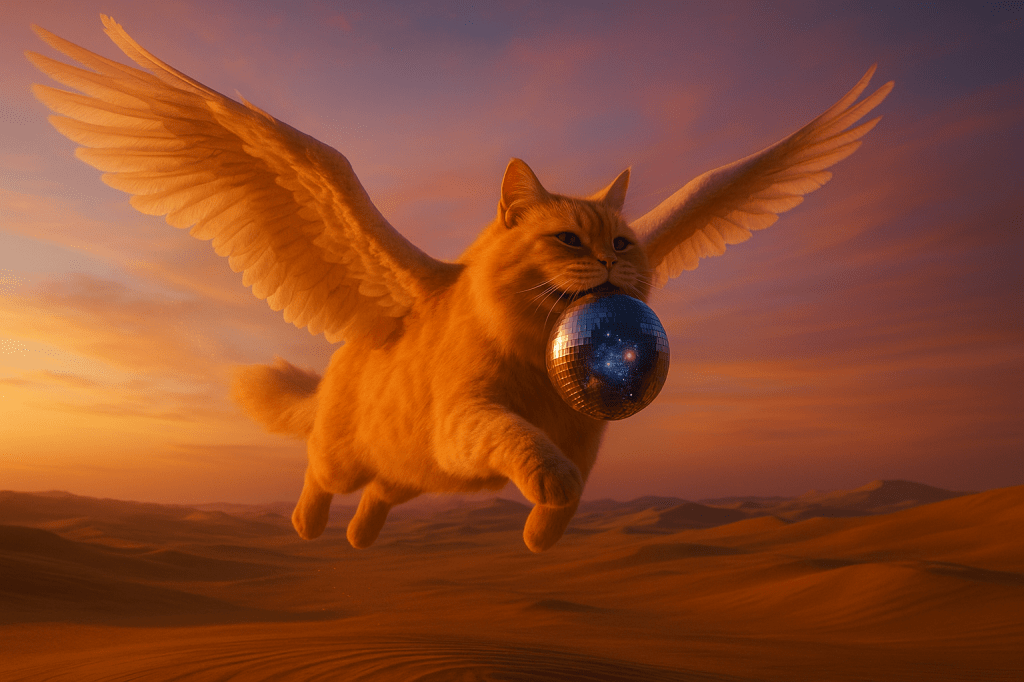
A hyper-realistic cinematic still of a massive, bus-sized golden-orange cat with soft, plush fur and vast angelic wings, soaring just above a golden desert at sunset. The cat appears joyful and majestic, its face lit by the warm hues of twilight. In its mouth, it gently carries a perfectly reflective disco ball—small in scale compared to the cat, but glowing from within, revealing an entire spinning miniature universe inside. Planets slowly orbit within it. Stars twinkle. Nebulae pulse in soft pinks and cosmic blue. The sky above the cat is a surreal blend of amber, rose gold, and rich lavender, capturing the sun’s last descent. Below, the desert dunes ripple like an ocean of golden silk, catching the warm light. The cat’s wings are vast and feathery, semi-translucent, shimmering with hints of iridescent lavender and pearl as the sunlight filters through them. A faint trail of desert wind and stardust swirls in its wake. Shot on an ARRI Alexa Mini LF with a 35mm anamorphic lens, cinematic aspect ratio (2.39:1), shallow depth of field, and high dynamic range color. The camera angle is low and dynamic, following behind and slightly below the cat, emphasizing scale and motion—evoking awe and surreal beauty. The scene blends ultra-realistic fantasy with dreamlike sci-fi, reminiscent of Denis Villeneuve’s ‘Dune’ fused with the surreal wonder of ‘Interstellar’ and the playful charm of Studio Ghibli.”
Try this:
- Love a certain artist? Try their style on something totally unhinged. A modern Monet about heartbreak, near a waterfall. Seawater lilies in a rooftop pool. Or upload a picture from your camera roll and remix it as a Dali painting.
- See something stunning? Photograph it, upload it, prompt from it. Color-match a stranger’s sari. Remix a sunset into fabric texture. Let the real world feed the machine.
- Build a reference bank. I document things that move me. Saw a Picasso, loved the palette. Fed it into Midjourney, rewrote it into a character. Inspiration is a loop.
Tips for Getting Weird (In a Good Way)
Detail is the difference. Treat your prompt like cinematography. Shot on a 2000 Kodak disposable. Film grain. Harsh flash. Yellowed border. Coffee stain. Mood, era, moment. The more specific you are, the better. Whatever details I leave out are mostly disappointing because the intended picture will look different from the vision.
As in my previous example, use lens language. Photographers might have an advantage here. Angles, shots, moods, the camera model being used. It gives the AI something real to work on.
Also, look at what others are making. Sora’s explore page? It’s a rabbit hole of what’s possible. You have the option of copying a prompt and adjusting the parts that you don’t like. I highly recommend this one.
New Creative Rituals for the AI Era
We’re not just making art anymore.
We’re inventing new ways of making.
AI isn’t just a tool. It’s something we’re learning to move with. Like a partner in a dance we’re still figuring out. And if we treat it like just another app, just another shortcut, we’re missing the point.
What’s happening now is deeper than workflow. It feels like ritual.
There’s something about how we engage with these models that invites new practices. Not just productivity hacks, but quiet, weird, personal rhythms. Ways of making that are both fast and slow. Machine-assisted and deeply human.
Some people are printing out AI images and collaging them by hand. Others are painting over Midjourney generations, turning digital files into tactile objects. Some are doing live prompt sessions like performances, improvising in real time. Even saving your best outputs and prompts becomes its own kind of practice—a sketchbook, a moodboard, a breadcrumb trail for your future self.
My favorite is translating AI into analog. Not stopping at the screen, but letting it push you back into the physical world.
Start with a Midjourney prompt like:
A teenage girl in Ramallah, disposable camera photo from August 12, 2003. Rooftop evening. Olive trees in the distance. Plastic patio chairs. A faded red water tank. Cousins playing cards on a woven mat. Faint Arabic music from a radio. Warm light from a bare bulb. A plate of watermelon slices. Sandals kicked off. Scratch on the lens. Dust in the air. Yellow date stamp: “12/08/03 20:17.
Let the AI get you 80% there. Then try to recreate it yourself. By hand. With a camera. With paint. With whatever medium you trust.
Texture is time travel. The machine gives you the scaffolding, but the final 20%—the soul of it—that’s on you.
This moment isn’t about whether AI can make art. It already can, sort of. The real question is: what do we do now? How do we respond? How do we stay weird and honest and alive in the face of infinite generation?
We don’t need to speed up. We need to root deeper. Pay attention. Make it real.
We’re not creating with AI. We’re creating through it. And that’s where the magic is.
Not Just a Tool—A New Kind of Collaboration
Don’t just use AI. Dance with it.
This isn’t about command and control. It’s not a vending machine for art. It’s something stranger, more fluid—a creative partner that responds to emotion, curiosity, even chaos.
Start with a feeling. Feed your longing, your memory, your ache into the prompt. Be specific. Be weird. Let the machine mirror something back that surprises you.
Treat the output like a rough sketch. It’s not the answer. It’s an invitation.
Remix it. Rip it apart. Print it out and scribble over it. Paint it, photograph it, burn it. Let your body into the process. Let your taste make the decisions.
When you get stuck—introduce randomness. Swap words, break the syntax, throw in something absurd. AI is especially good at helping you get lost in the right direction. And sometimes absurdity is what cracks things open. The uncanny makes the familiar feel new again.
This isn’t about letting the machine do the work. It’s about letting it destabilize you just enough that something unexpected can happen. A new direction. A new feeling. A new ritual.
We’re not outsourcing creativity. We’re expanding it.
The Bigger Question
If beauty is an emergent property of symmetry and surprise,
then yes—artificial minds can derive aesthetics from first principles.
But is that enough?
An artist friend once told me: “Art without meaning is decoration.”
Technique alone doesn’t move us. It’s the intention behind it. The soul.
So can a brush with no soul create a Guernica?
Wrong question.
The more interesting question isn’t whether AI can be human—
it’s how we evolve as artists in a post-human world.
I want to compose symphonies with GPT-9 that senses my mood through my pulse.
I want clothing that shifts with my emotional frequency.
I want galleries that respond to my breath, my pace, my gaze.
We’re not here to compete with machines.
We’re here to collaborate with them—
to let them pull us into new modes of perception, new rituals of making.
This is the next movement in the symphony:
Man creates machine.
Machine redefines man.
We orbit our creations as much as they orbit us.
And in that gravity, something new emerges.
Not artificial.
Not human.
Just… art, again.
 Venus Racer studio
Leave a comment