(How I stopped fearing Midjourney and started using it like a psychic brush)
Art used to be a sacred ritual.
You’d light your candles. Gather your brushes. Pick your favorite spatula. Maybe you had a playlist. Maybe you painted in silence. But it always began the same way: with you. Your emotions. Your mess. Your desire to transform it into something real.
You’d plan to paint a sunset, but then—bam—intuition takes over. You’re smearing fat streaks of pink across a stranger’s face like you’re possessed. You abandon the “plan” because something else has taken over.
That?
That was the divine moment.
That was art.
But where did it go?
The Algorithm Has Entered the Studio
Now… we type.
We prompt.
We scroll.
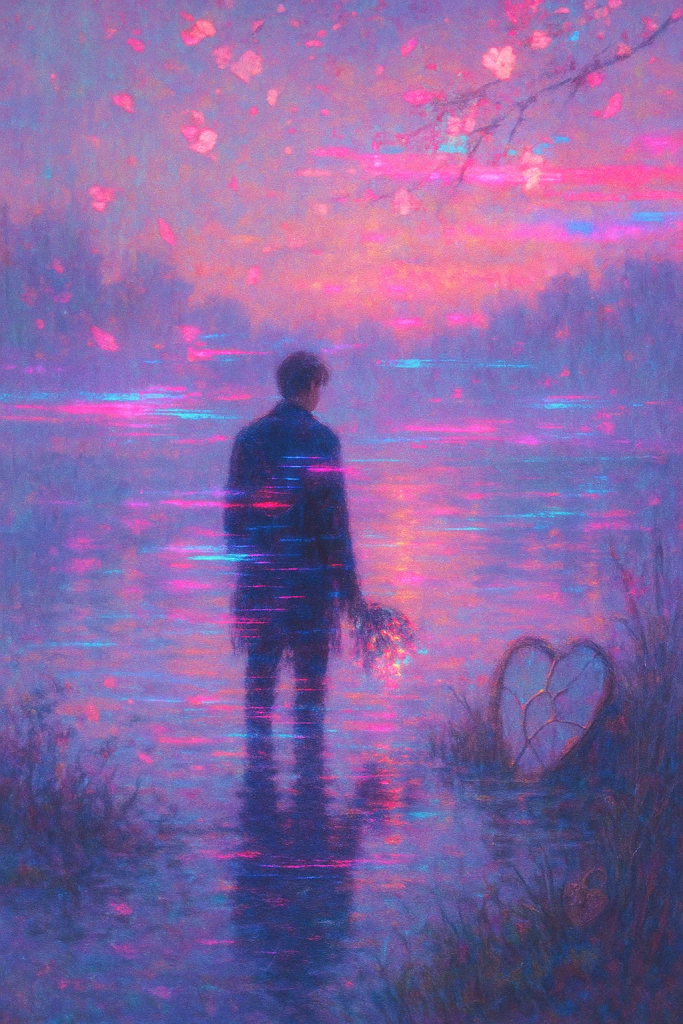
We ask machines to “give us something beautiful” in the style of Monet meets neon glitchwave with a touch of heartbreak.
And honestly?
It delivers.
AI-generated art is fast. It’s impressive. It can be heartbreakingly accurate.
And yes, it’s changing the game.
But it also begs the question:
Where the hell does intuition live in a world where creativity is automated?
Rethinking the Ritual: What If AI Isn’t the Death of Art—But the Expansion of It?
Look. I get the fear.
Every time something big shifts—whether it’s how we work, date, think, or make art—we panic.
We grieve the old world.
But what if this isn’t the end?
What if the ritual just changed?
What if we still made room for that subconscious magic—but instead of mixing pigments, we’re mixing modalities?
Here’s What I’m Dreaming Up:
- You’re heartbroken. You feed your pain into Midjourney. The output isn’t your final piece—it’s your starting point. You print it, and then paint over it. The machine gives you shape, but your brush gives it soul.
- You write a strange little scene with ChatGPT, something surreal and disturbing. Then you perform it—à la Marina Abramović—because it disturbed you. The AI becomes your sparring partner in a performance ritual.
- You build a new art style that’s AI-assisted but unmistakably yours. Think Van Gogh in the age of neural nets. Think signature glitches. Think emotion trained into an aesthetic no machine could copy without your essence baked in.
The Rise of the Intuition Technologist
Here’s the truth nobody wants to say:
The artists who will thrive in this new era won’t be the ones who cling to traditional skills like life rafts.
They’ll be the ones who translate their internal chaos into new tools, new methods, and new styles.
Your job isn’t to paint like you used to.
Your job is to discover how the same emotions—grief, lust, obsession, joy—can be extracted through machines.
Not to replace the muse.
But to amplify her.
But What About Authenticity?
Yes—handmade art will become fetishized.
It’ll be the new “analog luxury.”
Collectors will brag that a painting was made without any AI intervention. It’ll be a flex.
But authenticity is a moving target.
Today, it’s canvas.
Tomorrow, it’s intention.
Did you make something only you could have made—machine-assisted or not?
That’s what will matter.
So What Now?
We’re entering a strange and beautiful era.
The entry barrier to “good” art is lower than ever.
By the law of large numbers, this means some of the most extraordinary art in history will be born right now.
In basements. On borrowed laptops. With models trained on dead artists and live pain.
And YOU?
You get to decide what kind of artist you’ll be in this era.
Curator? Alchemist? Collaborator?
Or will you cling to an old ritual that no longer exists?
Final Thought
Creativity isn’t dying.
It’s mutating.
And maybe, just maybe, that’s exactly what art has always done.
 Venus Racer studio
Leave a comment