AI has automated execution.
You used to need skill to bring an idea to life. Now you need taste. In a world where you can build anything in minutes, the real power lies in knowing what deserves to exist.
The internet is already overflowing—overflowing-er now, if that’s possible. AI tools have turned content into a firehose. Whatever you can dream, you can make. Instantly. That spark of an idea? A few prompts later and it’s dressed, lit, rendered, ready for export.
The bottleneck has shifted.
It’s no longer how to make something.
It’s what to make—and why it matters.
“Art is beautiful, but it’s a lot of work.” – Karl Valentin
This quote used to hang in the art room back in school—charming then, but it hasn’t exactly aged like fine wine.
Idea generation? Easy.
Execution? Instant.
Strategy? Prompt-to-publish.
The question now is: What makes the cut?
What’s worth finishing? Sharing? Obsessing over?
What’s not just possible to make—but necessary?
The thrill of skipping the hard part
When I first started using Midjourney, I was drunk on possibility.
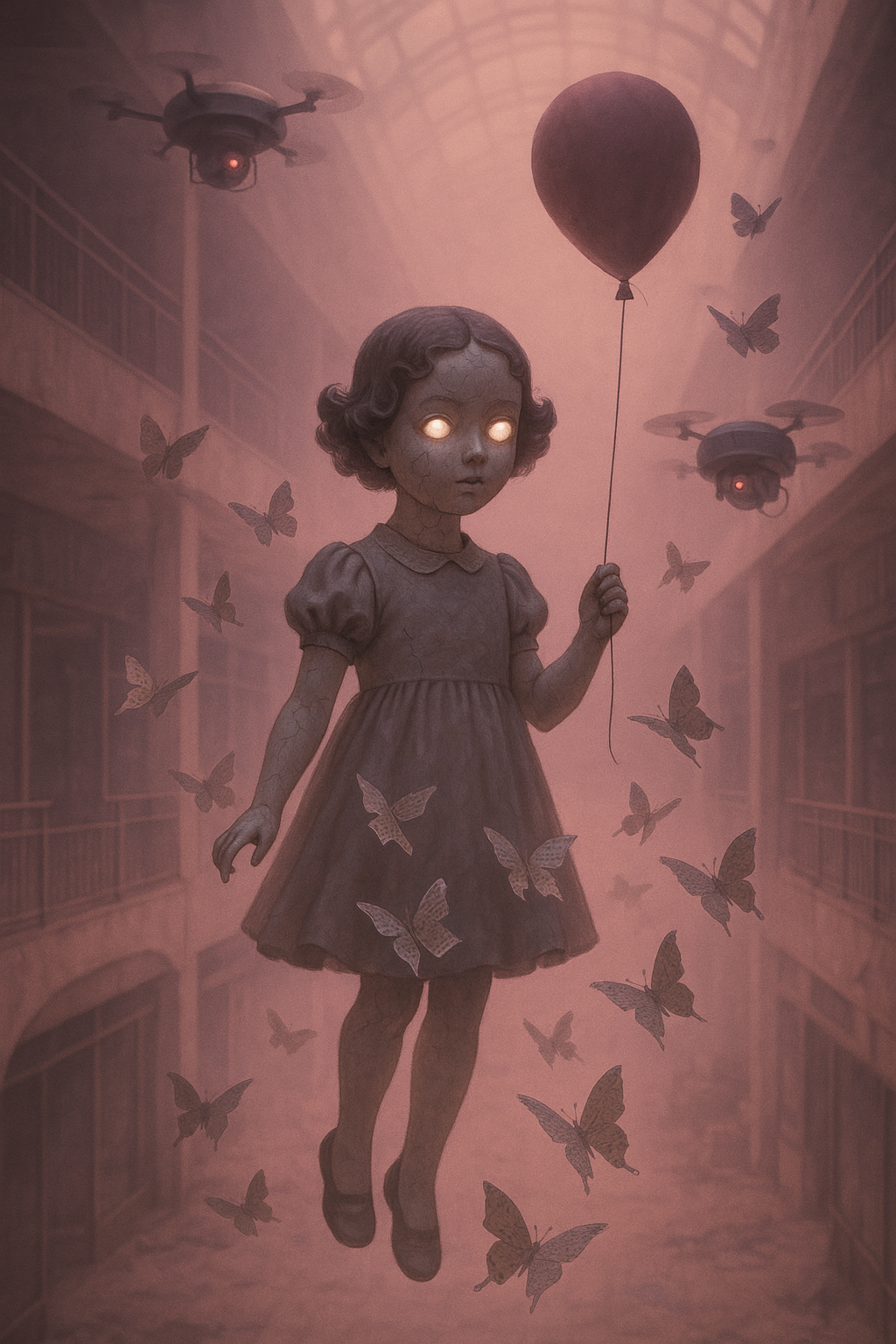
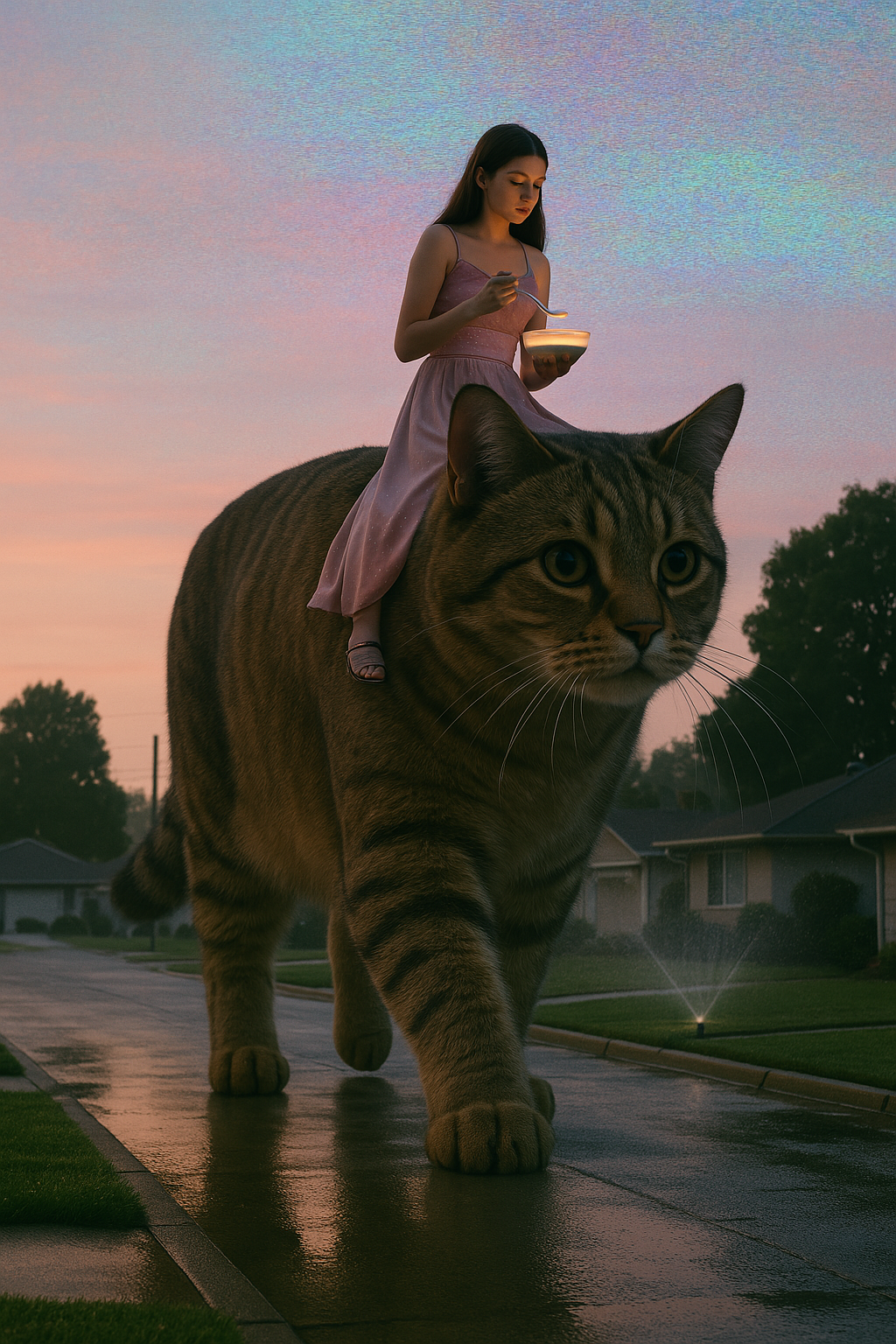
In seconds, I could render the images in my head: A porcelain girl with glowing eyes floats through an abandoned shopping mall flooded with soft pink fog. A giant house cat the size of a city bus slowly walks through a quiet suburban neighborhood at dawn. No one reacts. A teenage girl in a prom dress sits calmly on its back, eating cereal from a glowing bowl. Weird, vivid, impossible stuff—and suddenly, it wasn’t just in my brain anymore. It was real. Tangible. Shareable.
At first, it was intoxicating.
Then… a little disorienting.
Because something was missing. There was no struggle. No blank page. No hours of pushing through creative paralysis, no breakthrough moment after a block. Just… a very good result. Instantly.
That thrill flattened into something else: a quiet unease.
If everyone can make beautiful things now, what does beautiful even mean? Where does value live when output is infinite?
2. Execution has been commodified
Let’s be honest: AI didn’t just speed up creativity—it democratized excellence.
You no longer need years of technical skill to produce something impressive. You just need the right keywords, a good eye, and a decent bullshit filter.
So now, the real challenge isn’t execution. It’s selection.
What’s worth making? What’s worth keeping? What’s you?
Every one of us is becoming the curator of our own infinite museum. We’re swimming in content, tools, prompts, templates, presets. And somewhere in that flood, we have to make choices—ruthlessly. Thoughtfully. Maybe even weirdly.
But choice is exhausting. Decision fatigue is real. And still: this is where the game is won.
3. The new creative class: curators, not craftsmen
Before AI, the “elite” creatives were defined by craft: drawing, coding, composing, building. Now? The edge is in choosing, imagining, refining, remixing.
Designers feed their moodboards into gen models.
Writers spar with ChatGPT to chase ideas in odd directions.
Developers prompt Cursor like it’s a mildly sassy assistant.
Filmmakers use AI to previsualize entire storyboards before lifting a camera.
It’s less about being a solo genius, and more about being a hyper-collaborative, tool-savvy director of vibes.
You’re not writing a novel. You’re sculpting a narrative out of raw noise.
You’re not painting a picture. You’re tuning an aesthetic frequency only you can hear.
4. The danger: sameness, mimicry, over-optimization
But here’s the risk: if everyone uses the same tools, everything starts to look the same.
Same aesthetic. Same music. Same shiny, hyperreal, too-slick outputs.
We risk flattening the soul out of the work—turning creativity into content, story into spectacle, beauty into vibe-checked asset packs. Optimization becomes mimicry. Good taste becomes conformity.
And that’s the trap.
Because the goal of art isn’t to look good. It’s to hit. To move. To haunt.
That’s not something AI can do alone. That’s where you come in.
You—the editor, the curator, the final set of fingers making that last brutal cut. You’re the one who knows what doesn’t belong. Who can smell when something’s too clean, too safe, too easy.
5. The Real Differentiator: Constraints, Weirdness, and Signature Moves
When anything is possible, taste becomes the final frontier.
The edge now isn’t in output—it’s in filters. It’s in how you twist the tools, what you obsess over, what you insist on.
Not “what do you refuse to make?”
No.
What do you keep making even when no one asks for it?
What makes people say, “This could only come from you”?
A designer who strips out all color—because grayscale feels truer than palette.
A writer who uses AI to simulate arguments with their inner critic.
A musician who generates ambient noise and sings over it in one-take iPhone recordings.
An artist who prompts Midjourney only with breakup texts or therapy notes.
A brand strategist who trains their AI on forgotten IKEA catalogs from the ’90s.
These aren’t productivity hacks.
They’re signature moves. They’re weird, obsessive, specific. And that’s what gives them gravity.
The real flex isn’t “I used AI to make this.”
It’s: “Only I would’ve made this with it.”
We’re entering an era where the best creators aren’t just technically skilled.
They’re aesthetic cult leaders.
They don’t follow trends. They bend them. Break them.
They cultivate obsession—not just content.
They build creative worlds so rich, others want to live inside them.
And here’s the wild part:
They might never have picked up a paintbrush.
They might’ve never been accepted to an art school.
They might not even call themselves artists yet.
But AI gave them the tools. And their inner world did the rest.
Because in the age of infinite creation—
the most powerful thing you can be is unmistakably yourself.
That’s the real art now.
 Venus Racer studio
Leave a comment